
Procure Group Ltd · Northampton & surrounding areas
Damp Surveys in Northampton
A damp survey should tell you what is causing the moisture, not just confirm that moisture exists. Procure Group Ltd carries out investigation-led damp surveys, damp inspections and damp assessments across Northampton and the surrounding area, so that any treatment recommended afterwards is proportionate to the actual cause.
What you receive
A professional written report, in plain terms
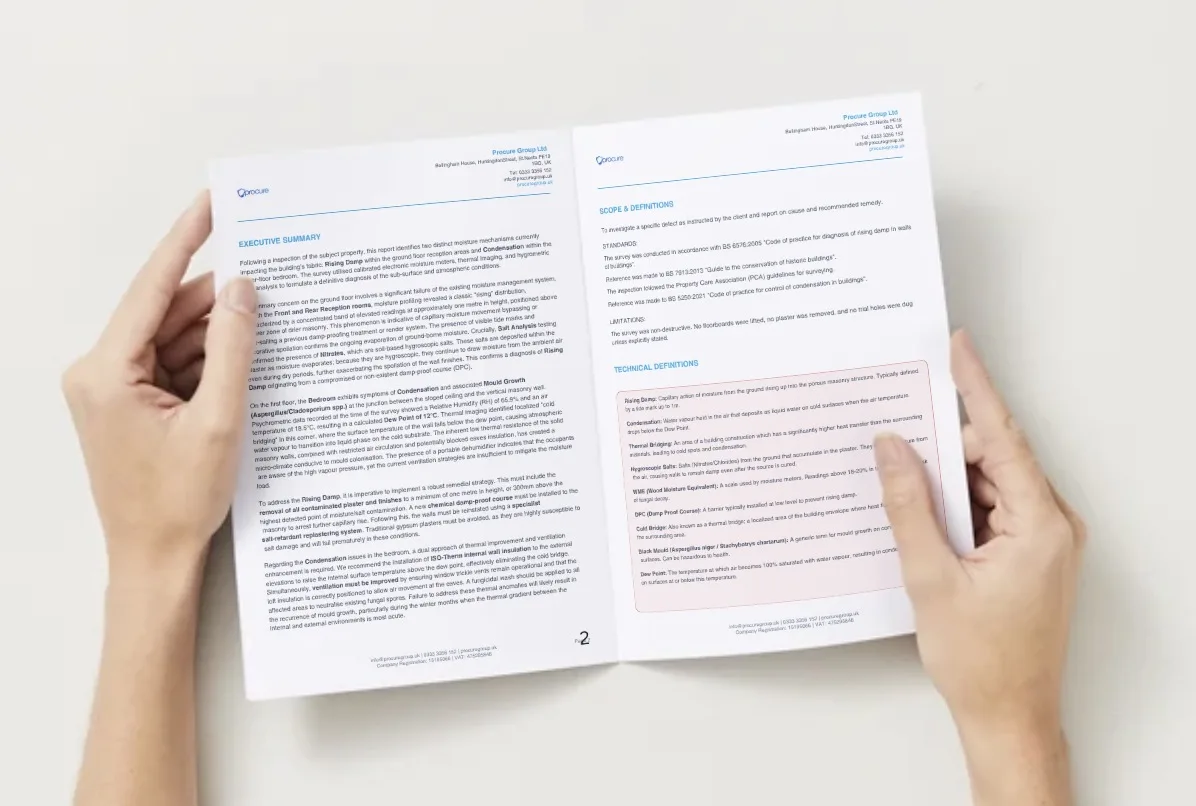
Every Procure Group survey concludes with a clear written report — observations, evidence, likely cause and recommendations, with necessary, advisory and optional items separated.

Investigation before treatment
Most damp treatments fail for one simple reason: they were specified before anyone established what was actually causing the problem. Damp is a symptom, not a diagnosis, and the same visible symptoms — stained walls, peeling paint, black mould, musty smells — can be produced by very different causes.
A Procure Group damp survey is built around a single question: what is the most likely cause of the moisture in this property? Only once that question is answered on evidence do we discuss remedies.
What a proper investigation may include
Depending on the property and the symptoms, a damp investigation may draw on several complementary methods rather than any single test:
- Visual inspection of the affected areas and the building as a whole
- Moisture profiling to map how moisture is distributed through a wall or floor
- Assessment of the property's construction, age and materials
- Assessment of internal and external defects — gutters, pointing, render, ground levels and drainage
- Atmospheric readings, including relative humidity and air temperature
- Surface temperature measurement and condensation risk assessment
- Ventilation assessment, including extract and background ventilation
- Thermal imaging where appropriate
- Timber inspection where floors, joists or embedded timbers may be affected
- Salt analysis where applicable, to help distinguish rising damp from other causes
- Recommendations for further opening-up where concealed defects cannot be assessed non-invasively
What a moisture meter can and cannot tell you
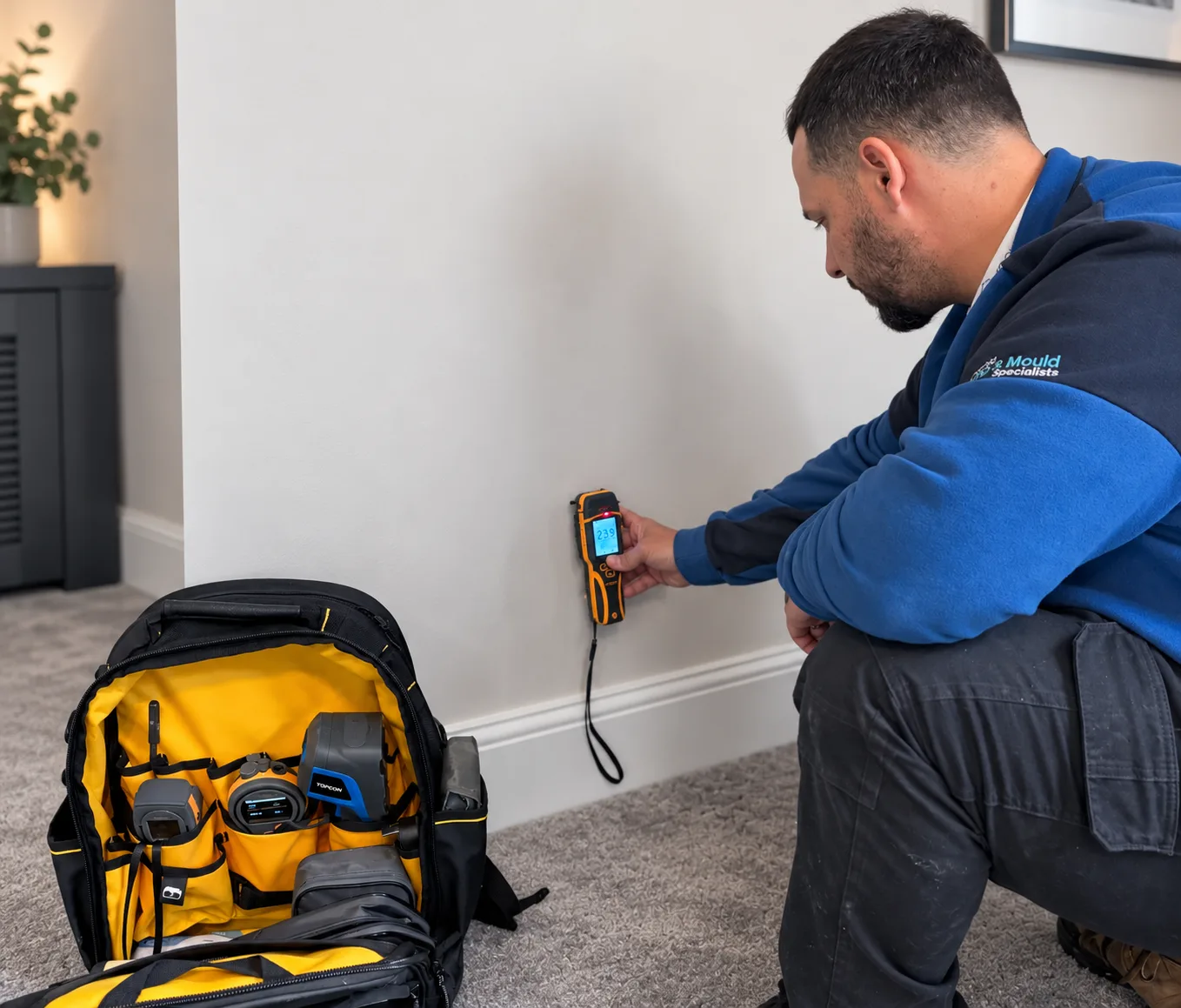
An electronic moisture meter is a useful tool, but it does not diagnose damp on its own. Hand-held meters are influenced by surface salts, condensation and the material being tested, and a high reading at the bottom of a wall does not, by itself, confirm rising damp.
We use moisture readings as one piece of evidence among several — interpreted alongside the pattern of moisture, the construction of the building and the conditions inside it. That is the difference between measuring moisture and investigating damp.
Inspection limitations, stated honestly
A non-invasive survey cannot see behind every surface. Where a defect is likely to be concealed — behind dry lining, beneath flooring or within a wall cavity — we will tell you what can and cannot be concluded, and recommend proportionate opening-up only where it is genuinely needed to reach a reliable answer.
What you receive
You receive a clear written report setting out our observations, the evidence gathered, the likely cause of the problem and our recommendations. Necessary, advisory and optional items are separated so you can see exactly what matters and why.
Book a Damp Survey in Northampton
Tell us what you are seeing and upload photographs if you can. We will review your enquiry and arrange the appropriate assessment.